Map 20 · Partition and history
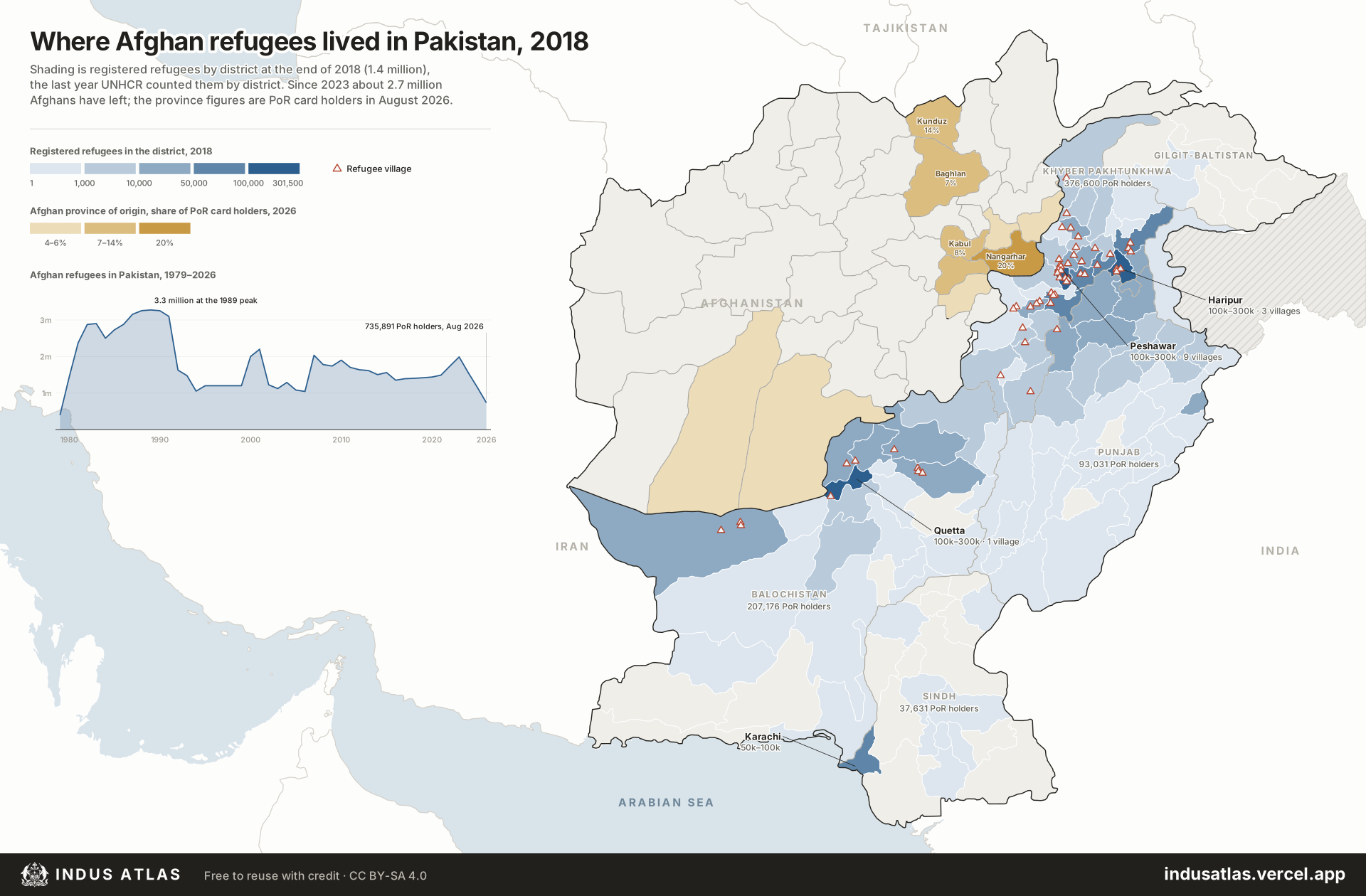
Where Afghan refugees lived in Pakistan, 2018
- Region
- Pakistan, 1979–2026
- Data
- UNHCR district bands (2018), refugee villages and province of origin (2026), PoR card holders by province and refugees by year.
- Rule
- Districts shaded by registered refugees, in UNHCR’s five bands; triangles are refugee villages; Afghan provinces shaded by where PoR card holders come from.
The district shading shows registered Afghan refugees at the end of 2018 (1.4 million), the last year UNHCR published counts by district; it is not where refugees live today. Since Pakistan’s expulsion drive began in 2023, about 2.7 million Afghans have returned or been deported, and registered (PoR) card holders have fallen from 1.32 million to 735,891 (August 2026), shown as the province figures on the map.
Pakistan has hosted Afghan refugees since the Soviet invasion of December 1979. UNHCR counted 3.3 million at the 1989 peak, most of them in camps along the border in what is now Khyber Pakhtunkhwa and Balochistan. Waves went home in 1992 and 2002, and the 2006–07 registration gave about 2 million Afghans a Proof of Registration (PoR) card. The map shades each district by the number of registered refugees at the end of 2018, the last time UNHCR published them by district: 1.4 million people, a third of them in the 54 refugee villages, the rest in towns and cities. Peshawar, Quetta and Haripur held more than 100,000 each. Since Pakistan’s expulsion drive began in 2023 the number of PoR holders has almost halved, to 735,891 in August 2026. Afghan provinces are shaded by where today’s PoR holders say they come from: one in five from Nangarhar, across the Khyber Pass.
Indus AtlasFree to reuse with credit · CC BY-SA 4.0indusatlas.vercel.app
Hover or tap a district, village or Afghan province.
PoR card holders by province
| Province | Dec 2022 | Aug 2026 | Change |
|---|---|---|---|
| Khyber Pakhtunkhwa | 691,239 | 376,600 | -46% |
| Balochistan | 318,914 | 207,176 | -35% |
| Punjab | 188,579 | 93,031 | -51% |
| Sindh | 72,745 | 37,631 | -48% |
| Islamabad | 40,463 | 19,361 | -52% |
| Azad Kashmir | 4,317 | 2,092 | -52% |
| All Pakistan | 1,316,257 | 735,891 | -44% |
Refugees and returns, selected years
| Year | Event | Refugees in Pakistan | Returned that year |
|---|---|---|---|
| 1980 | Soviet invasion (December 1979) | 1,428,230 | 0 |
| 1989 | Soviet withdrawal; the peak | 3,272,290 | 0 |
| 1992 | Mujahideen take Kabul; 1.36 million go home | 1,627,000 | 1,360,000 |
| 1996 | Taliban take Kabul | 1,200,000 | 140,390 |
| 2001 | US invasion | 2,197,821 | 8,000 |
| 2002 | Taliban fall; 1.57 million go home | 1,226,569 | 1,569,248 |
| 2007 | PoR card registration | 2,034,416 | 365,663 |
| 2016 | Pressure after the Peshawar school attack; 381,275 go home | 1,352,160 | 381,275 |
| 2021 | Taliban return to power | 1,490,562 | 451 |
| 2023 | Pakistan orders undocumented Afghans out | 1,987,717 | 490,891 |
| 2025 | ACC and PoR holders ordered out | 1,158,538 | 1,125,946 |
- UNHCR stopped publishing district counts after 2018, so the district bands are from its map of 31 December 2018. They were read off that map by matching its district outlines to the pre-2018 districts used here. Its legend lists two districts above 100,000; the map colours three (Peshawar, Quetta and Haripur).
- Refugee villages are placed where UNHCR’s June 2026 overview map draws them, within about 5 km: 43 in Khyber Pakhtunkhwa, 10 in Balochistan and 1 in Punjab (Peshawar 9, Mansehra 3, Haripur 3, Hangu 3, Loralai 3, Chagai 3, Lower Dir 2, Buner 2).
- Refugee numbers are UNHCR’s end-of-year figures; 2026 is PoR card holders in August. The jump in 2007 is the PoR registration, which counted Afghans outside the camps for the first time. Returns before 2023 count only registered refugees going home; from 15 September 2023 they count everyone who crossed back, including undocumented Afghans and deportees.
- About 666,000 Afghan Citizen Card holders and an unknown number of undocumented Afghans also live in Pakistan; neither is shown by district.
All places
Every place on the map. Select a row to find it on the plate.
163 places
| 100,001 to 301,500 | |
| 100,001 to 301,500 | |
| 100,001 to 301,500 | |
| 50,001 to 100,000 | |
| 50,001 to 100,000 | |
| 50,001 to 100,000 | |
| 50,001 to 100,000 | |
| 50,001 to 100,000 | |
| 10,001 to 50,000 | |
| 10,001 to 50,000 | |
| 10,001 to 50,000 | |
| 10,001 to 50,000 | |
| 10,001 to 50,000 | |
| 10,001 to 50,000 | |
| 10,001 to 50,000 | |
| 10,001 to 50,000 | |
| 10,001 to 50,000 | |
| 10,001 to 50,000 | |
| 10,001 to 50,000 | |
| 10,001 to 50,000 | |
| 10,001 to 50,000 | |
| 10,001 to 50,000 | |
| 10,001 to 50,000 | |
| 10,001 to 50,000 | |
| 1,001 to 10,000 | |
| 1,001 to 10,000 | |
| 1,001 to 10,000 | |
| 1,001 to 10,000 | |
| 1,001 to 10,000 | |
| 1,001 to 10,000 | |
| 1,001 to 10,000 | |
| 1,001 to 10,000 | |
| 1,001 to 10,000 | |
| 1,001 to 10,000 | |
| 1,001 to 10,000 | |
| 1,001 to 10,000 | |
| 1,001 to 10,000 | |
| 1,001 to 10,000 | |
| 1,001 to 10,000 | |
| 1,001 to 10,000 | |
| 1,001 to 10,000 | |
| 1,001 to 10,000 | |
| 1,001 to 10,000 | |
| 1,001 to 10,000 | |
| 1,001 to 10,000 | |
| 1,001 to 10,000 | |
| 1,001 to 10,000 | |
| 20.4% | |
| 14.2% | |
| 8.3% |
Sources
- UNHCR Pakistan, Pakistan: Overview of Afghan Refugee Population and UNHCR Operational Presence, 31 December 2018, and Overview of Refugees and Afghans of Other Status in Pakistan, 30 June 2026 (data.unhcr.org/en/country/pak); PoR card holders by province from the UNHCR operational data portal, December 2022 to August 2026.
- UNHCR Refugee Data Finder, refugees from Afghanistan in Pakistan and returns, 1979–2025 (api.unhcr.org/population/v1).
- Pakistan and Afghanistan: geoBoundaries PAK ADM2 (pre-2018 districts) and AFG ADM1; neighbouring countries from Natural Earth; crossing points from GeoNames.